- About
-
-
- The Shaar
-
-
- Prayer
-
-
- Media
-
-
-
- Life
-
-
- Lifecycle
Events
-
-
- Venues
-
-
-
-
- Community
-
-
- Adult Engagement
-
-
- Youth and
Young Families
-
-
- Tikkun Olam
-
-
-
-
- Music
-
-
- SH’MA
-
-
-
- Learning
-
-
- Adult Education
-
-
-
-
- Calendars
-
-
- Calendar
-
-
-
- Daily Services
- eNewsletter Sign-Up
- My Account

In September 2023, prominent Canadian Jewish artist Yehouda Chaki z”l passed away at the age of 84. Among the many wonderful contributions to art in Canada, Chaki, a long-time member of our own Shaar community, was behind the design of the two beautiful tapestries sewn by the Sisterhood, depicting scenes from Bereshit, which hang in our building. This week, as we begin another Torah reading cycle on Simchat Torah, we pay tribute to Yehouda Chaki and the two tapestries.
In The Beginning
The first Chaki-designed tapestry, “In The Beginning”, was unveiled by the Sisterhood in 1982 and took two and a half years to complete. In the fall of that year, at the reception preceding the Slichot services, the Sisterhood sponsored a vernissage of the tapestry as part of the Westmount Arts Festival. This was the first public viewing of the tapestry, and was attended by guests and officials of the City of Westmount, along with Sisterhood members who made squares in the tapestry and Yehouda Chaki himself
Let There Be Light
In 1992, in time for the Congregation’s 145th anniversary, the Sisterhood unveiled its second needlepoint tapestry designed by Yehouda Chaki titled, “Let There Be Light”. This was another great undertaking by members of the Sisterhood who each completed squares of the tapestry. The Committee for this project was chaired by Mildred B. Lande, C.M., and Carol Koffler.
Further reading on Yehouda Chaki
Brownstein: Chaki was one of Canada’s most prominent and prolific artists
Obituary: Yehouda Chaki, 84, expressed both joy and pain in his vibrant paintings
Thank you to all those who tuned in on November 27th for the very well-attended Archives Roadshow (Part Two)! If you were unable to make it, the recording of the event is now available. In this program, you will learn about four Jewish archives in Canada, and about one fascinating item in our own synagogue archives which sheds light on an important part of our synagogue’s history and our contributions to Canadian Jewish history!
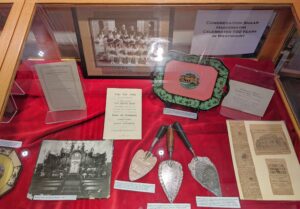
Shaar Centennial in Westmount Exhibit at Westmount Public Library: Until October 19th, visit the Westmount Public Library to see an exclusive exhibit in celebration of the Shaar’s centennial in Westmount featuring selections from the synagogue’s museum and archival collections.

How the Shaar has memorialized and celebrated the British Monarch
In early February of 1901, Congregation Shaar Hashomayim held a memorial service for Queen Victoria. This Saturday evening, as we mark one hundred years in our own building, we will be holding our fifth memorial service for a reigning sovereign: Her Majesty Queen Elizabeth II, who sat on the throne for most of that century. In a newly mounted display outside of the Chapel, we exhibit how our congregation has celebrated and memorialized momentous occasions for Canada’s monarchs, from Queen Victoria to Queen Elizabeth II.
Shaar Hashomayim was founded in 1846—just nine years into Queen Victoria’s reign. Since her passing in 1901, our Congregation has held memorial services upon the death of every Canadian Sovereign. Over the past year, we have shared how the Shaar has marked the coronation of Queen Elizabeth II (in honour of her Platinum Jubilee), the Diamond Jubilee of Queen Victoria (185 years since her ascension to the throne in 1837), and the death of King George VI (70 years this year). Yet we have far more materials documenting the Shaar’s respect for the Canadian Monarchy within the synagogue’s archives. In the display you will find materials relating to the reigns of Queen Victoria, King Edward VII, King George V, King George VI, and Queen Elizabeth II. (Of course, the only one missing is King Edward VIII, whose reign lasted under a year).
As you peruse the display you may notice that some of the pamphlets were printed and distributed by the Office of the Chief Rabbi of the British Empire (later United Kingdom and the Commonwealth), to whose leadership our own Congregation often looked, as we aligned ourselves with the British tradition. Another interesting paper to note is a letter from the office of the Governor General of Canada, thanking the Congregation for their official sympathies upon the death of King Edward VII in 1910.
Willesden Jewish Cemetery
Willesden Jewish Cemetery is a Victorian-era cemetery founded in 1873 which has long been considered a prestigious place of burial. Many prominent Jews are buried there, including numerous Chief Rabbis of the British Empire, various members of the Rothschild family, many scholars and scientists, writers, poets, artists, and more.
Among the many people buried here are three past presidents of the Shaar Hashomayim, all members of the Moss family, who were among the earliest members of the congregation. As I am currently on a trip to London, I took a visit to the cemetery to visit their places of burial.
The Moss Family
When Congregation Shaar Hashomayim was founded in 1846 as a breakaway congregation from Shearith Israel (the Spanish and Portuguese), it consisted of only a handful of families. It took the congregation some time to find its footing. It was only when the prominent Moss family, who had established a successful business, joined the congregation that things began to move in more productive directions. The first generation of the family, brothers David, Edward, and Lawrence Moss, all born in England, were all integral members of the community. Both David and Edward were early presidents of the synagogue. It was David Moss who laid the cornerstone of the first building on St. Constant Street. Through Lawrence Moss died while still in Montreal, his two brothers both eventually returned to London where they remained for the rest of their lives.
Edward’s son John E. Moss and David’s son Hyam D. Moss (some records refer to him as Hyman) remained and became leaders of the congregation in their own right. John served as president of the congregation from 1885 to 1890 and Hyam as the congregation’s president in 1871 and 1881–4, as well as parnass. Yet eventually this second generation left for England too.
Why did the Moss family leave?
Rabbi Shuchat offers a plausible explanation for this in his book The Gate of Heaven: The Story of Congregation Shaar Hashomayim in Montreal, 1846–1896:
“This was a pattern followed by many families at the time… Why did they do so? For one thing, many of them regarded England as home and Canada as a temporary sojourn. If they were in a family business, they felt that they had spent enough time in the branch and wanted to return to the home office. Some families thought that their children would have better opportunities for marriage in England. There was also the question of being with family again and possibly being buried close to relatives. Presumably these considerations applied to the Moss family.” (p. 41–2)
Edward Moss
Edward Moss was born in London in 1816. He serviced as Shaar President in 1864, and died in 1876, just 11 years after leaving Canada. The front and side of his tombstone reads:
“Sacred to the Memory Edward Moss Esq. of Inverness Terrace, Hyde Park, who departed this life December 8th 1876 5637, aged 62 years. Deeply regretted by his sorrowing widow and children and a large circle of friends. May his soul rest in peace.”
“This monument was erected by his bereaved widow and children as a tribute of their love to the dear departed. He was a friend to all and his good deeds will follow him for many years. He was a resident of Montreal, Canada and his good works there remain to perpetuate his memory. “A good name is better than precious ointment”.”
John E. Moss
John E. Moss was born in Montreal around 1843 and left for London in 1890 where he died in 1902. The years of his presidency were fruitful. It was under his leadership that the construction of the McGill College building was completed and the synagogue officially adopted the Shaar Hashomayim name. As Rabbi Shuchat writes in his book:
“At a meeting just prior to the consecration, John Moss, the president, offered this interpretation of the new name: ‘Only a year ago many of us thought it was only a dream and would never be carried out. But I am glad to be able to say to you to-day that if a dream it was, it was not unlike the vision of our Father Jacob who saw a ladder the summit which reached the Gate of Heaven. So we in our fond dream have been permitted to create the ladder of progress which will bring us up to the House of God which by the way will be designated, Shaar Hashomayim, the Gate of Heaven.’” (p. 40)
Hyam David Moss
Hyam D. Moss was born in Montreal c. 1845 and served as the congregation’s treasurer and parnass, and later president in 1871 and 1881–4.
Following the unexpected dislodging of a time capsule from the 1967 cornerstone during construction on the Côte-Saint-Antoine plaza, we decided to act proactively and have the 1922 cornerstone of the building scanned.
With the help of Radex who scanned the stone, we made the following exciting discovery: there is a metal tube centered in the 1922 cornerstone, indicating there is a more than 90% chance of something having been placed there. Given that it is a metal tube, the likelihood is quite high that this is yet another time capsule!
To gain a better read on the stone, the technician asked to scan the cornerstone from the building’s interior. Given the synagogue’s many renovations and expansions over the years, we pulled out the synagogue’s many architectural drawings and plans to investigate further.
If there is indeed a time capsule, we will be taking additional steps to carefully remove and open the 1922 cornerstone so that the time capsule itself can be opened in time for our upcoming re-dedication of the sanctuary on September 17th of this year. Stay tuned as we continue our research…
A few weeks ago, we wrote about a time capsule which was dislodged from the 1967 cornerstone of the building. This week, some 55 years later, we’re sharing in greater detail just what that time capsule contains.
Canada, Montreal, and the Shaar in 1967
1967 was a monumental year for Canada, Montreal, Jewish Canadians, Israel, and the Shaar. Canada was marking its centennial; Montreal was at the centre of the worlds’ stage as the host of Expo 67 (at which the Shaar’ Rabbi Shuchat created the Pavilion of Judaism); and Israel had just won the 6-day war.
Meanwhile, Montreal’s Jewish community and, as a result, the Shaar’s membership, was greatly expanding. It became evident that the Shaar would need to expand to accommodate the increase in congregants. The congregation launched a campaign entitled “Progress Through Expansion” to raise funds for the expansion and, on October 1, 1967, the cornerstone was laid.
So what’s in the time capsule?
The time capsule contains a diverse array of documents. The first are materials that provide context about Canada in 1967 and Jews in 1967. This includes a few pamphlets and papers relating to Canada’s centennial and Expo 67, and a time magazine issue about the 6-day war.
The rest of the documents in the time capsule all relate to the Shaar. This includes the printed New Years Announcements from 1967, the program for the laying of the cornerstone, a photograph of the Shaar building prior to the expansion, and the text of the sermon delivered by Rabbi Shuchat on the occasion of the laying of the cornerstone, tantalizingly entitled “The To-Morrow of the Shaar,” in which he reflects on the history of the Shaar and the future of the Shaar moving forward as they expand.
Most fascinating above all, however, are three letters from the Synagogue’s then-President Dr. Harry Ballon, the synagogue’s Parnass Jules Roos, and from Rabbi Shuchat. In Rabbi Shuchat’s letter he begins “To the Rabbi and President of Congregation Shaar Hashomayim many years hence-shalom!” He then details what to find in the time capsule and ends with the following reflection: “We are far from living in a world of peace. The Jewish People after the terrible destruction of the Nazi Period 1933-1945 are making spiritual and national progress everywhere except in Soviet Russia.”
http://Link to full documents in the time capsule
Lyon Cohen (1868-1937) was a benevolent philanthropist, not just in the Montreal Jewish community, but across Canada and played an integral part in the establishment of many Jewish organizations. Cohen devoted his life to the Jewish community and served in many leadership roles, including as the first president of Canadian Jewish Congress and as a founder of the Jewish Immigrant Aid Society (JIAS) and co-founder of The Jewish Chronical among many others. Lyon Cohen was also a long-time President of the Shaar, serving two terms (1904-1907; 1914-1932) for a total of 21 years. The synagogue and the congregation grew immensely during those years, during which time Cohen oversaw the construction of the Shaar’s current building on Cote St Antoine.
“From an historical point of view, a period of one and a half years can be summarized in one sentence. In Lyon Cohen’s case, he admitted in one of his reports that he spent more time at the construction site than at his business. First thing in the morning, on the way to his office, he would visit the construction site, and if there was a crisis there, he might never get to the office that day.”
– The Gate of Heaven, Chapter 7. Rabbi Wilfred Shuchat
https://images.shulcloud.com/1057/uploads/SUMMER-ARCHIVE-PROJECT/LYONCOHEN1924PRESIDENTSSPEECH.pdf
Introducing The Summer Archival Project
Over the winter of 2021, Rabbi Shuchat’s file cabinets were brought out of storage and slowly the task of sifting through Rabbi Herman Abramowitz and Rabbi Wilfred Shuchat files began. Due to COVID-19 restrictions, I worked alone, passionate about preserving the Shaar’s rich history, however I quickly realized that this project would require a professional archivist. As restrictions eased and with the support of a Canada Summer Jobs, we were delighted to welcome Hannah Srour, a recent graduate of the Master of Information program at the University of Toronto, where she concentrated in Archives & Library Science.
Since joining the Shaar at the end of June, she along with my guidance and the volunteer help of Aviya Scheier and Kinneret Finegold have uncovered many exciting finds among Rabbi Shuchat’s papers, including personal letters from Abraham Heschel, A. M. Klein, and Chaim Potok, records about Leonard Cohen’s youth involvement at the synagogue, and various materials related to the Pavilion of Judaism at Expo ’67 to name but a few.
Follow us in the Shaar’s enewsletter as we continue to share our discoveries and ask for your help in piecing together more of our Shaar’s history.
Claire Berger – museum@theshaar.org