- About
-
-
- The Shaar
-
-
- Prayer
-
-
- Media
-
-
-
- Life
-
-
- Lifecycle
Events
-
-
- Venues
-
-
-
-
- Community
-
-
- Adult Engagement
-
-
- Youth and
Young Families
-
-
- Tikkun Olam
-
-
-
-
- Music
-
-
- SH’MA
-
-
-
- Learning
-
-
- Adult Education
-
-
-
-
- Calendars
-
-
- Calendar
-
-
-
- Daily Services
- eNewsletter Sign-Up
- My Account

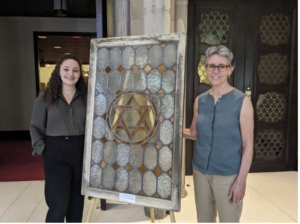
It’s been a very interesting week for us at the Shaar Archives and Museum! On Monday, we were visited by Simcha Shtull, who is in Montreal filming a documentary about the stained-glass windows of the old Shomrim Laboker synagogue building on St. Dominque, one of which is in the Shaar’s Museum collection. For the documentary, our archivist Hannah Srour-Zackon was interviewed about the window, the history of the Shaar, and the importance of preserving Jewish history.
The Shtull family purchased the Shomrim Laboker building in the 1950s (when the synagogue moved to Plamondon and Westbury) and used it for their egg and butter distribution business. When the business closed, the stained-glass windows all ended up in different places. For the documentary, Simcha Shtull is tracing the journey of each of the windows. We are so excited to be a part of this story and look forward to seeing the documentary when it’s finished!
On Shavuot, we celebrate the receiving of the Torah – the Book of Books, the source of the Jewish People’s designation as the ‘People of the Book’. It is fitting, then, that the Shaar has a wonderful collection of rare books in our collection. Among them is one particularly fascinating book: A handwritten manuscript book of haftarot produced in Yemen in the early 19th C.
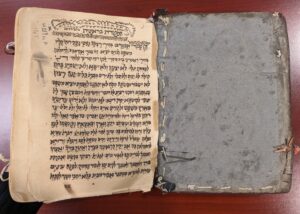
The first page of the manuscript book.
Little is known about this fascinating volume – we don’t know anything about its scribe nor what year it entered the collection. The hand of the scribe, with its occasional unevenness and ink smudges, suggests a true human quality to each production. Each haftarah begins with an embellished title, indicating a new section. Note also that each page ends with the word to look for on the following page. The following pages show the haftarot we will read on Shavuot.
Shavuot haftarah, page 1

Shavuot haftarah, page 2

Shavuot haftarah, page 3. The haftarah for the second day of Shavuot begins midway down the page on the right.

Shauvot haftarah, page 4

This small ceramic seder plate (c. 1895), with a pale pink rim and blue centre, has a fascinating history. It was originally donated to the Shaar’s museum by Jeanie Rosemarin (the sister-in-law of long-time Shaar music director Prof. Jacob Rosemarin) in 1987, and it was brought over from Eastern Europe by her parents. Aside from its beauty, a mark on the back of the plate gives a major clue to its history…
On the back is written “Kamennobrod – A.F. Sussman”. With a bit of research, this indicates it was made at the faience (fine tin-glazed pottery) factory in Kamenny Brod (modern-day Ukraine).
Kamenny Brod only began to develop in the second half of the 19th century—during which time the factory was established. Towards the last quarter of the 1800s, ownership of the factory was taken over by the Sussman family, who developed it into the largest faience factory in the region. This attracted a number of Jews to move to the town. Indeed, the factory quickly became the economic heart of the town, employing much of the local population.
Under Aizik (A. F.) Sussman’s leadership, the factory gained a reputation for its beautiful craftmanship. Sussman brought the factories’ best pieces to international exhibitions such as in Poltava (1895), Odessa (1897), and Kyiv, where they won numerous awards.
This seder plate may just be a mere snippet of a long history, but it offers a window to the past, and its presence in the Shaar’s museum collection offers a chance to connect with this history.
The seder plate is currently on display outside of the Shaar’s main office. If you’re interested in reading more about Kamenny Brod and its faience factory, an excellent and detailed history is available at the below links:
Sources:
https://kehilalinks.jewishgen.org/kamennyy_Brod/history-faience_factory.htm
https://kehilalinks.jewishgen.org/Kamennyy_Brod/KamennyyHistory.pdf
The Haggadah has a history of not only being one of the most produced Jewish books (with some estimates citing more than 5,000 published versions), but one of the most beautifully decorated as well. The tradition of artfully produced Haggadot dates back to the medieval era (13th century) when such Haggadot as the Golden Haggadah and the fascinating Birds’ Head Haggadah. This tradition has continued into even recent years with the emergence of artist’s books Haggadot. The Shaar Hashomayim Museum and Archives is proud to have one such Haggadah in our collection: the Ya’akov Boussidan Haggadah.
Ya’akov Boussidan is an Israeli artist who, born in Port Said, Egypt, came to Israel with his family in 1949 as a child. His works have been acquired by such places The Victoria and Albert Museum in London, The Metropolitan Museum of Art in New York, The Boston Museum of Fine Arts, and the Israel Museum in Jerusalem.
Among the many works Boussidan has produced, in the 1970s he undertook a project to create his own Haggadah. These Haggadot took several years to make in Boussidan’s London-based studio and include 30 colour etchings. An interesting aspect of Boussidan’s Haggadah is the incorporation of the story of creation from Bereishit.
The Haggadah was finally finished in 1975 and it is a breathtaking work of art. There are merely 60 copies in the whole world. As noted in the etchings in the book, the copy in the Shaar’s museum collection is number 10, and was gifted in 1981 by Dr. and Mrs. William Cohen.
If you are interested in seeing the Haggadah in person, please reach out to museum@theshaar.org to make an appointment.
Further Reading:
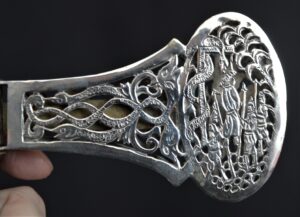
Towards the end of 2022 the Shaar Hashomayim Museum and Archives received a most fascinating gift: Charles Kaplan, reached out to offer the commemorative silver trowel to his grandfather—Past Shaar President Moses Jacob (M. J.) Heillig z”l—on the occasion of the laying of the cornerstone of the Rabbi Herman Abramowitz Educational Annex on October 31, 1948. We were, of course, delighted to reencounter this important artifact of the Shaar’s history.
The Trowel in Focus
The silver trowel is similar in design to those already in the museum’s possession from other cornerstone-laying occasions in the synagogue’s history. It is engraved with the following message:
Presented to M. J. Heillig, Esq. President of Congregation Shaar Hashomayim on the occasion of the laying of the Corner Stone for the Rabbi Herman Abramowitz Building. Oct. 31st 1948. 23rd Day Tishrei 5709.
At the base of the handle where it meets the silver plate is a small figure of an open Torah scroll.
Who was M. J. Heillig?
Moses Heillig served as the president of the synagogue from 1947-1956, but these years merely represent a fraction of the many years in service to the Shaar. In fact, Heillig’s years in uninterrupted service to the Synagogue total well over a half century, making him the longest serving member in the history of the synagogue. Beginning when he was merely in his early twenties, he became the secretary of the synagogue and would go on to serve as vice-president, president, honorary president, and as chairman of Cemetery Committee from 1945 for many decades.
What happened during the cornerstone laying ceremony?
On November 5, 1948, the Canadian Jewish Review reported the following:
The newly-constructed educational annex, to be known as the Rabbi Herman Abramowitz Building was dedicated and formally opened, the Rabbi and Cantor Nathan Mendelson officiating, with the choir under the direction of Jacob Rosemarin, with Mrs. M. N. Fineberg at the organ. The Ark was opened by Ronald Cape, president of the Junior Congregation, Horace R. Cohen, O.B.E, honorary president of the congregation, presided. Greetings were extended on behalf of Mayor R. P. Adams of Westmount by Alderman G. L. Fowler. The Montreal Protestant School Board was represented by its chairman, W. E. Dunton, and the Westmount Board of School Commissioners by C. H. Savage. The cornerstone was placed by M. J. Heillig, the president, and the formal presentation of the building was made by Max Finestone, chairman of the Building Committee, to Philip Lev, chairman of the Education Committee. The educational director, Samuel L. Leibowitz affixed to the doorpost the traditional mezuzah. Junior congregation simchas Torah Hakofos were conducted at evening and morning services by the officers and cantors, Ronald Cape presided; Arthur [obscured] acted as parnass; David cape as [obscured]; and Morton Schwartz read from the Torah. The Ark was opened by Lewis Batshaw and Leonard Cohen. Participants were: Howard Bacal, Harold Shapiro, Perry Meyer, Bernard Cooper, Joseph Mendel, Mark Shapiro, Mark Bercuvitz, Basil Ballon, Daniel Usher, Arthur Freedman, Jerry Freedman, Jerry Kurland, Harvey smith, Robert Feldstein, Murray Notkin, Haskell Zabitsky, Avrum Bloomstone, Allan Bernfeld, Charles Solomon, Marvin Goldsmith, Bernard Shapiro, Martin Goodman, Harold Scherzer, Ronald Gallay.”
We express our sincerest gratitude to Mr. Kaplan for his wonderful gift which will be preserved among the history of our synagogue in perpetuity.
Hava narishah – rash, rash, rash! Purim is less than two weeks away! This week we’re featuring some of the beautiful megillot and groggers from the Shaar’s museum collection.
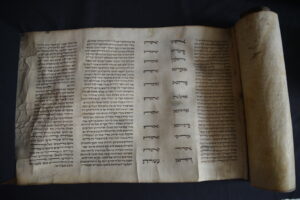
This remarkable megillah (c. 1830), written on parchment made of sheepskin, originates from Oran, Algeria, which had a large Jewish community. This was gifted to the Shaar by Gordon L. Echenberg.

There are a few megillot in the collection which are encased in some beautiful silver cases. Pictured above is one of these megillot, made in Eastern Europe in the mid 19th-Century. Gifted to the Shaar by Mr. Harold Lande, 1991
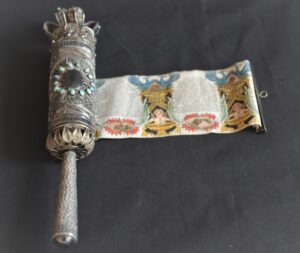
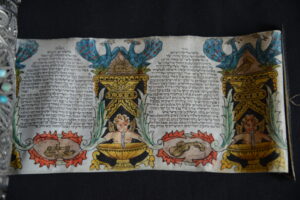
This megillah, with a silver filigree case, encrusted with turquoise and garnets, was made in the early 19th Century in the Middle East. Particularly impressive is the scroll itself, handwritten on parchment, and illustrated with blue peacocks, musical instruments, and mythical figures. The scroll was made around 1920 in Palestine. Gifted to the Shaar by Mrs. Max Y. Klein, Mrs. Gerald Weiner, and Mrs. Kenneth Shere in memory of their mother Edith Rosen, October 8, 1977.
Groggers
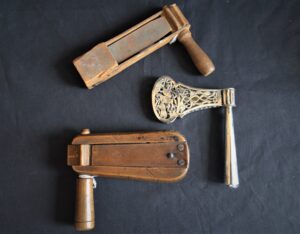
While many groggers we use these days are typically made of either metal or plastic, this was not always the case! In our collection, we have two wood groggers, and another made of silver. The grogger featured at the top of this photograph was made in Poland in the early 20th century. The other wood grogger (oak) at the bottom, was made in 1850. This one was gifted to the Shaar by the Guttman family in honour of Joseph Guttman’s birthday, 1985. It was initially purchased in Ripon, England at an antique fair.
The silver grogger in the middle, made in the United States between 1920 and 1930, was a gift of Michael Lax in memory of his father, Dr. Sam Lax (April 14, 1980). This grogger is also quite ornately decorated.
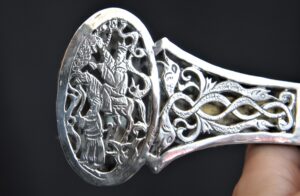
The grogger depicts two instances in megillat esther where Haman is humiliated or bested by the Jews whom he sought to eradicate. One side depicts the scene in which Haman is made to lead Mordechai on the king’s horse, declaring to all that this is what is done to one whom the king wants to honour. The other side depicts Haman hanging on the gallows.
Though Shabbat in Montreal will continue to end early for the next while, nightfall is gradually getting later week by week, and so is the recitation of Havdalah. Among Shaar Hashomayim’s impressive museum items are a collection of silver besamim boxes (Havdalah spice boxes). These were mostly designed in the 19th century (like the two presented below), when besamim boxes in the form of towers were especially popular.
The spice box to the right, standing at approximately 13 cm in height, is in form of leaves on a vine, and originates from Russia. It was gifted to the Shaar by Ethel Gallaman, this was a family heirloom of her mother, Mrs. Joseph Gallaman.
The spice tower to the left originates from Italy. The centre of the tower, which holds the spices, is in the shape of a casket adorned with a pomegranate on the lid. The casket’s intricate filigree design is a mark of fine Italian craftmanship.
An up close view of the intricate filigree design.
The spice tower to the left, though of unknown origin, was likely created circa 1800. Four flags surround the box, with an additional one on the top. When using this spice tower, however, one would best be very careful—those flags are quite sharp! This was gifted to the Shaar in 1979 by Mrs. Esther Goldenberg Heller, in memory of her husband, Dr. Benjamin P. Heller.
The besamim box to the right, also of unknown origin, interestingly places the box at the base rather than in the middle of the tower structure (you may be able to spot a tiny handle to open the slot). Six flags ornament the top of the tower (one flag is missing). This tower is also adorned with a number of small bells around the sides and one larger bell in the centre, all shaped like pomegranates, reminiscent of the rimonim that adorn Torah scrolls. One can imagine the sounds that this would make when being passed around during Havdalah! Inscribed around centre of the tower is the following: “Gift to Congregation Shaar Hashomayim by Mr. and Mrs. A. Fleming on the occasion of the Bar Mitzvah of their son, Stephan Cecil, May 17, 1952 (5712)”.
The Shaar’s museum holds many fascinating Judaica items in its collection, including a number of books. This week we are featuring three beautiful books, all printed or composed around the late 18th and early 19th centuries, that are a part of our museum collections.
Siddur Safah Berurah
This gorgeous siddur, donated to the Shaar in 1988, was printed in Rödelheim in 1825 by the prolific German publisher, printer, and exegete Wolf Heidenheim (whose signature is printed on the title page). Heidenheim was born in 1757, and in 1799 established his printing house in Rödelheim, where it continued to operate for many years, including beyond his death in 1832. Besides this siddur, Wolf Heidenheim published numerous other editions of Jewish and Hebrew texts, including some with his own commentaries.
The edition shown seems to have been bound and engraved to be presented to a specific person: the front of the siddur features a silver medallion symbol of a family lion and the hands of the Kohanim, and the back has a silver medallion with the initials of the bride to whom this siddur was presented. The contents of the siddur itself are printed in Hebrew, Yiddish, and German and, as seen on the page adjacent to the title page, include some beautiful and detailed decorative engravings.
Handwritten Yemenite book of Haftorah / Haftorot
In the photograph are pictured two beautiful Hebrew books originating in Yemen. The larger of the two is a handwritten Yemenite book (Hebrew and Targum) of the Prophetic readings (Haftorah) composed in the early 19th century. Little else is unfortunately known about this beautiful manuscript book.
Siddur Kol-Bo
The smaller book is the Kol-Bo siddur (all inclusive, i.e., daily and holiday prayers all in one), composed circa 1750, which is bound in leather. This was gifted to the Shaar by Rabbi Charles Bender in honour of Mr. Allan Bronfman in 1968. The book is handwritten on vellum in Hebrew and Aramaic by a scribe whose name is not legible, though is inscribed in the book is, “the devoted, dedicated, and spirited Gabbay Tzedakah (Wardens of Charity) at Lisbon,” indicating the involvement of a person who collected and managed tzedakah funds.
Though things may be a bit more closed again these days, the Shaar’s archives are still open and at work. While January 2022 is looking a lot like January 2021, it is also looking a lot like September 1904! For our first item of 2022, we’re featuring an unusual (but incredibly familiar item) that was rediscovered some months ago in our collections – two cards certifying vaccination protection from around 1904 that allowed the card-carrier passage onto ships and any subsequent railroad travel in Canada.
The back of both read “Keep this card to avoid detention at quarantine and on railroads in Canada.” These may have been issued as a response to ongoing smallpox outbreaks in the United States. The signature of the certifying medical professional on both is visible. It is unclear at this time how the Shaar came to be in possession of these fascinating documents. Though from over 100 years ago, these vaccination passes are similar to our own vaccine passports today. Things that seem new and novel, such measures that encourage vaccination, may not be so novel after all!
As we start the new year, we at the archives want to know, what kind of items would you like to see and what kind of stories from the Shaar’s collections do you want to hear?
Continuing from last week, this week we’re featuring chanukiyot from around the world in the Shaar’s museum collection.
This bronze oil chanukiah from Morcco (c. 1860), though corroded over time, is still a remarkable piece. The back depicts the Tree of Life and the lions of Judah along with other motifs of Moroccan folk art. Unlike the chanukiyot we commonly use today, this chanukiah has a hook on the back and was meant to hang from the wall.
An early Bezalel chanukiah made in 1915. Written on the back is the following: “Made in Palestine at the art workshop of Sharar Betzalel, Jerusalem, P.O.B. 729.” The ornate design depicts biblical imagery of a lion and deer in front of palm trees. The centre shows the high priest (Kohen Ha-Gadol) lighting the menorah in the temple, assisted by a young boy carrying two jars of oil. At the top is written: “Ha-neirot hallalu kadosh hem.” Gift of Mrs. Esther G. Heller in memory of her parents, Adela and Maurice Goldenberg (parents of Senator Carl Goldenberg).
A silver and alloy handcrafted chanukiah made in Canada, between 1915-1925. The back shows two lions holding a crown.
This absolutely stunning chanukiah from Poland (c. 19th C) is made of German silver. The back plate is made of brass and depicts two lions around a menorah. This chanukiah interestingly has two shamushim. The company that made this chanukiah was a Warsaw-based silver foundry called the “Brothers Henneberg” which was founded in the mid-19th century. Gift from wedding of Mrs. Jeanne (Lazare) Rosemarin. Donated to the Shaar in January 1987.
A chanukiah from East India (19th C.) Brass engraved, crude pattern on surface. Gift of Mrs. Morris Gelber, 1986