- About
-
-
- The Shaar
-
-
- Prayer
-
-
- Media
-
-
-
- Life
-
-
- Lifecycle
Events
-
-
- Venues
-
-
-
-
- Community
-
-
- Adult Engagement
-
-
- Youth and
Young Families
-
-
- Tikkun Olam
-
-
-
-
- Music
-
-
- SH’MA
-
-
-
- Learning
-
-
- Adult Education
-
-
-
-
- Calendars
-
-
- Calendar
-
-
-
- Daily Services
- eNewsletter Sign-Up
- My Account

This small ceramic seder plate (c. 1895), with a pale pink rim and blue centre, has a fascinating history. It was originally donated to the Shaar’s museum by Jeanie Rosemarin (the sister-in-law of long-time Shaar music director Prof. Jacob Rosemarin) in 1987, and it was brought over from Eastern Europe by her parents. Aside from its beauty, a mark on the back of the plate gives a major clue to its history…
On the back is written “Kamennobrod – A.F. Sussman”. With a bit of research, this indicates it was made at the faience (fine tin-glazed pottery) factory in Kamenny Brod (modern-day Ukraine).
Kamenny Brod only began to develop in the second half of the 19th century—during which time the factory was established. Towards the last quarter of the 1800s, ownership of the factory was taken over by the Sussman family, who developed it into the largest faience factory in the region. This attracted a number of Jews to move to the town. Indeed, the factory quickly became the economic heart of the town, employing much of the local population.
Under Aizik (A. F.) Sussman’s leadership, the factory gained a reputation for its beautiful craftmanship. Sussman brought the factories’ best pieces to international exhibitions such as in Poltava (1895), Odessa (1897), and Kyiv, where they won numerous awards.
This seder plate may just be a mere snippet of a long history, but it offers a window to the past, and its presence in the Shaar’s museum collection offers a chance to connect with this history.
The seder plate is currently on display outside of the Shaar’s main office. If you’re interested in reading more about Kamenny Brod and its faience factory, an excellent and detailed history is available at the below links:
Sources:
https://kehilalinks.jewishgen.org/kamennyy_Brod/history-faience_factory.htm
https://kehilalinks.jewishgen.org/Kamennyy_Brod/KamennyyHistory.pdf
The Haggadah has a history of not only being one of the most produced Jewish books (with some estimates citing more than 5,000 published versions), but one of the most beautifully decorated as well. The tradition of artfully produced Haggadot dates back to the medieval era (13th century) when such Haggadot as the Golden Haggadah and the fascinating Birds’ Head Haggadah. This tradition has continued into even recent years with the emergence of artist’s books Haggadot. The Shaar Hashomayim Museum and Archives is proud to have one such Haggadah in our collection: the Ya’akov Boussidan Haggadah.
Ya’akov Boussidan is an Israeli artist who, born in Port Said, Egypt, came to Israel with his family in 1949 as a child. His works have been acquired by such places The Victoria and Albert Museum in London, The Metropolitan Museum of Art in New York, The Boston Museum of Fine Arts, and the Israel Museum in Jerusalem.
Among the many works Boussidan has produced, in the 1970s he undertook a project to create his own Haggadah. These Haggadot took several years to make in Boussidan’s London-based studio and include 30 colour etchings. An interesting aspect of Boussidan’s Haggadah is the incorporation of the story of creation from Bereishit.
The Haggadah was finally finished in 1975 and it is a breathtaking work of art. There are merely 60 copies in the whole world. As noted in the etchings in the book, the copy in the Shaar’s museum collection is number 10, and was gifted in 1981 by Dr. and Mrs. William Cohen.
If you are interested in seeing the Haggadah in person, please reach out to museum@theshaar.org to make an appointment.
Further Reading:
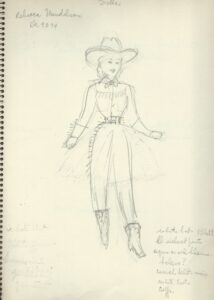
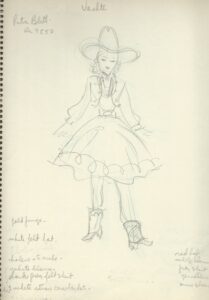
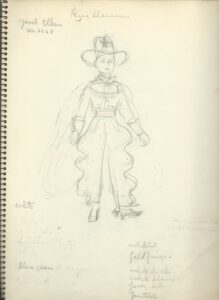
The Shaar’s tradition of elaborately produced Purimspiels put on by the youth of the synagogue carried on for decades. This week we’re featuring some of the original costume sketches from the Purimspiel of 1954, “Hopalong Haman Rides Again”
This Purimspiel—which was a parody of the 1937 Western Hopalong Rides Again was performed Thursday March 18th on Erev Purim.
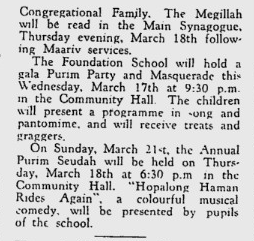
Among the cast members included Rebecca Mendelson as Esther, Rita Blitt as Vashti, Lorne Mendel as Mordecai, Jeffrey Weissler as Haman, and Jacob Elkin as Ahasuerus.
The costume sketches which you’ll see below are the original renderings. Each kid was dressed in appropriate ‘cowboy’-themed costumes to go with the theme of the Purimspiel.
Esther:
Vashti:
Mordecai:
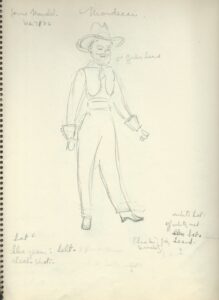
Haman:
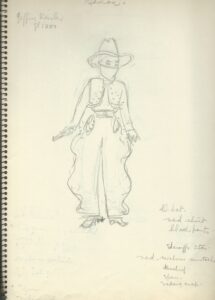
King Ahasuerus:
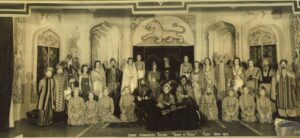
Last year, The Shaar Hashomayim Museum & Archives rediscovered a treasure trove of photographs from past Purim celebrations at the Shaar. Among these photographs were several large and fascinating cast pictures from the elaborate Purimspiels the youth of the synagogue would put on every year. This week we’re featuring the Purimspiel of 1939: Purim in Persia.
As reported in the Canadian Jewish Chronicle on March 3rd of that year, the Purimspiel, directed by Mr. Samuel Lerner, was to be performed on Sunday March 5th and was the highlight of the synagogue’s annual Purim banquet. The musical was based on a script written by Moshe Davis—an American rabbi who taught for many years at both the Jewish Theological Seminary and at the Hebrew University.

Here is how the paper reported the production prior to its performance:
“‘Purim in Persia,’ a musical comedy in two acts and five scenes, adapted by Mr. S. Lerner, from the script of Moshe Davis, will be the main feature of the Eleventh Annual Purim Banquet at the Shaar Hashomayim Synagogue next Sunday evening, March 5th, at 6 pm.
The cast of the play includes Horace Baittle, Mindel Bronfman, Neil Phillips, Lazarus Cohen, Edward Levinson, Leslie Brodkin, Bernard Berlin, Ian Lemco, Samuel Getz, Peter Rosenbaum, Edgar Wener, Sheila Abbey, Reva Leibovich, Gordon Edelstone, Marilyn Block, Sybil Freedman, Peter Bronfman, Edgar Bronfman, David Lemco, Donald Kirk, Billy Levy, Allan Kirsch, Perry Meyer, Anita Elkin, Katherine Silver, Florence Gersovitz, Wylma Jacobs, Naomi Pressman, Selman Schachter, Joyce Lozinski, Arthur Victor and Alan Finestone.
The play is under the direction of Mr. S. Lerner, with the music provided by Mrs. N. Fineberg. Fred Solomon is stage manager.”
In the following week’s issue of the Canadian Jewish Chronicle, it was reported that the production was so popular that it would be perform an encore performance the following Sunday (March 12th)
Sources:
1. https://news.google.com/newspapers?nid=2Q0AJrNhS-QC&dat=19390303&printsec=frontpage&hl=en
2. https://news.google.com/newspapers?nid=2Q0AJrNhS-QC&dat=19390310&printsec=frontpage&hl=en
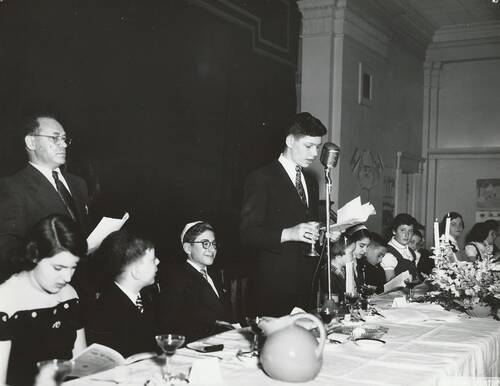
We recently found a wonderful photograph taken of a class seder at the Shaar’s Religious School in the spring of 1950 which has us reminiscing of model seders and Passovers past at the Shaar.
Here are some wonderful memories some of you have shared already:
“How I remember those years—[I] just loved the model Seders and practicing for them! We all knew the Seders by heart by the time they came around.” – Beverley Levitt Hamburg
“Each year as we choose our haggadot, we invariably come across the older copies with our model Seder “parts” complete with classmates’ names penciled in the margin and read with great confidence the role assigned to us all those years ago at the Shaar Afternoon school” – Anonymous
Thus far, we have identified the following people in the picture: Beverley Levitt Hamburg, Michael Cape (seated, wearing glasses), David Shapiro (the young man who is making kiddush), and Mr. Leibowitz (standing at the back).
Now, we want your help with identifying the rest! If you know anyone in the picture, or want to share your Shaar model seder and pesach memories, follow the form below:
https://forms.office.com/r/UdS42hZ5gX
Though Purim has passed, we’re still going through our recently rediscovered treasure trove of Purim pictures! To wrap-up our Purim content for this year, featured this week is the cast photograph from the 1938 Purimspiel entitled “The Rise and Fall of the Hamantash.”

Photograph donated by Marjorie Kirsch
The following was written about the Purimspiel in the March 25, 1938, edition of the Shaar’s bulletin:
SCHOOL CELEBRATES PURIM
Over 400 pupils and parents came together last Sunday morning for the Purim Celebration of our Religious School. The celebration took place in the Synagogue Auditorium.
The gathering was made welcome by Dr. H. Abramowitz, who spoke a few words of Purim greeting. It was announced that the total of Shalach Monos Baskets sent out by the School had been increased to thirty-three. The Women’s Auxiliary Society, and a small local social group were thanked for adding their contributions to the baskets.
“The Fall and Rise of the Hamantash”, a Purim Operetta in two acts, under the direction of Mr. S. Lerner, featured the celebration. The characters of the Book of Esther were portrayed by Horace Baittle, Meta Levin, Leslie Brodkin, Harold Finestone and Anita Elkin. The Hamantash was Peter Bronfman.
Others who participated were Sybil Freedman, Zipporah Batshaw, David Marshall, Judith Marshall, Billy Levy, Katherine Silver, Charles Bronfman, Edward Bronfman, Trevor Fineberg, Burril Fine, Donald Kirk, Allan Kirsch, Edgar Leibovich, David Robinson, Natalie Raginsky, Carmel Schwartz, Herbert Siblin, Lillian Brown, Florence Gersovitz, Beatrice Kirsch, Marguerite Kirsch, Naomi Pressman, Merle Rosenthal, Phyllis Sabbath, Vivian Zacks, Ronald Burg, Sidney Aronson, Barbara Flanders, Jerrold Fineberg, Eugene Gordon, Paul Gordon, Reva Leibovich, Edward Levinson, Shirley Levitt, Seymour Pressman, Renee Raginsky, Judith Rothbart, Eli Solomon, Fred Solomon, Alvin Shiller, Martin Taub, Arthur Victor.
The music was provided by Mrs. M. N. Fineberg. Victor Goldbloom was Stage Manager.
Special thanks are due to Mrs. Philip Levy, who assisted with the make-up and costuming; to the Hebrew Ladies Sewing Society, who kindly lent a hand in making the costumes; and also to Mr. T. Price and his assistant, Mr. Bert Lovering, for cheerful co-operation.
The celebration concluded with the Purim Treat distributed to the pupils of the School by our Women’s Auxiliary Society.
Purimshpiels are plays or skits that are performed on Purim, and that typically playing satirize the Purim story. The history of purimshpiels goes back several centuries and is connected to the history of Yiddish theatre. Over the course of the 19th and 20th centuries, purimshpiels evolved, including into professional performances that would sometimes parody popular shows of the day. At the Shaar Hashomayim, purimshpiels and plays have been a mainstay of Purim celebrations over the course of its 175-year history! Ahead of Purim, enjoy some of the wonderful photographs from the archives which showcase some of those elaborate productions and pageants. If you recognize yourself or anyone in the photographs, please reach out to us at museum@theshaar.org!
How many Honorary Past Presidents can you find?
Click here to view the full gallery
Hava narishah – rash, rash, rash! Purim is less than two weeks away! This week we’re featuring some of the beautiful megillot and groggers from the Shaar’s museum collection.
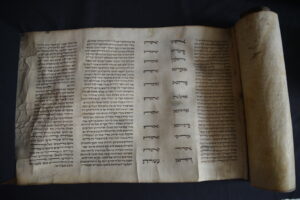
This remarkable megillah (c. 1830), written on parchment made of sheepskin, originates from Oran, Algeria, which had a large Jewish community. This was gifted to the Shaar by Gordon L. Echenberg.

There are a few megillot in the collection which are encased in some beautiful silver cases. Pictured above is one of these megillot, made in Eastern Europe in the mid 19th-Century. Gifted to the Shaar by Mr. Harold Lande, 1991
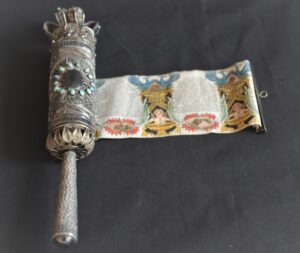
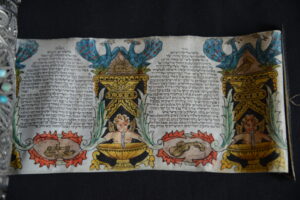
This megillah, with a silver filigree case, encrusted with turquoise and garnets, was made in the early 19th Century in the Middle East. Particularly impressive is the scroll itself, handwritten on parchment, and illustrated with blue peacocks, musical instruments, and mythical figures. The scroll was made around 1920 in Palestine. Gifted to the Shaar by Mrs. Max Y. Klein, Mrs. Gerald Weiner, and Mrs. Kenneth Shere in memory of their mother Edith Rosen, October 8, 1977.
Groggers
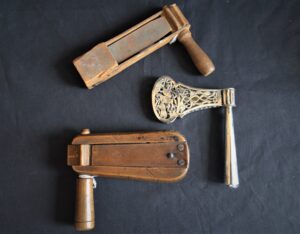
While many groggers we use these days are typically made of either metal or plastic, this was not always the case! In our collection, we have two wood groggers, and another made of silver. The grogger featured at the top of this photograph was made in Poland in the early 20th century. The other wood grogger (oak) at the bottom, was made in 1850. This one was gifted to the Shaar by the Guttman family in honour of Joseph Guttman’s birthday, 1985. It was initially purchased in Ripon, England at an antique fair.
The silver grogger in the middle, made in the United States between 1920 and 1930, was a gift of Michael Lax in memory of his father, Dr. Sam Lax (April 14, 1980). This grogger is also quite ornately decorated.
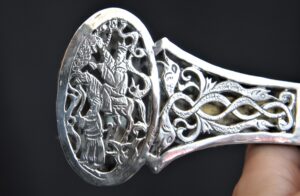
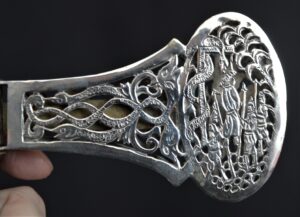
The grogger depicts two instances in megillat esther where Haman is humiliated or bested by the Jews whom he sought to eradicate. One side depicts the scene in which Haman is made to lead Mordechai on the king’s horse, declaring to all that this is what is done to one whom the king wants to honour. The other side depicts Haman hanging on the gallows.
Continuing from last week, this week we’re featuring chanukiyot from around the world in the Shaar’s museum collection.
This bronze oil chanukiah from Morcco (c. 1860), though corroded over time, is still a remarkable piece. The back depicts the Tree of Life and the lions of Judah along with other motifs of Moroccan folk art. Unlike the chanukiyot we commonly use today, this chanukiah has a hook on the back and was meant to hang from the wall.
An early Bezalel chanukiah made in 1915. Written on the back is the following: “Made in Palestine at the art workshop of Sharar Betzalel, Jerusalem, P.O.B. 729.” The ornate design depicts biblical imagery of a lion and deer in front of palm trees. The centre shows the high priest (Kohen Ha-Gadol) lighting the menorah in the temple, assisted by a young boy carrying two jars of oil. At the top is written: “Ha-neirot hallalu kadosh hem.” Gift of Mrs. Esther G. Heller in memory of her parents, Adela and Maurice Goldenberg (parents of Senator Carl Goldenberg).
A silver and alloy handcrafted chanukiah made in Canada, between 1915-1925. The back shows two lions holding a crown.
This absolutely stunning chanukiah from Poland (c. 19th C) is made of German silver. The back plate is made of brass and depicts two lions around a menorah. This chanukiah interestingly has two shamushim. The company that made this chanukiah was a Warsaw-based silver foundry called the “Brothers Henneberg” which was founded in the mid-19th century. Gift from wedding of Mrs. Jeanne (Lazare) Rosemarin. Donated to the Shaar in January 1987.
A chanukiah from East India (19th C.) Brass engraved, crude pattern on surface. Gift of Mrs. Morris Gelber, 1986