- About
-
-
- The Shaar
-
-
- Prayer
-
-
- Media
-
-
-
- Life
-
-
- Lifecycle
Events
-
-
- Venues
-
-
-
-
- Community
-
-
- Adult Engagement
-
-
- Youth and
Young Families
-
-
- Tikkun Olam
-
-
-
-
- Music
-
-
- SH’MA
-
-
-
- Learning
-
-
- Adult Education
-
-
-
-
- Calendars
-
-
- Calendar
-
-
-
- Daily Services
- eNewsletter Sign-Up
- My Account

As we continue to feature highlights from the remarkable wedding collection in the Shaar’s archives, in this article we’re showcasing weddings of the 1930s and 1940s, including weddings which took place during World War II!
Weddings of the 1930s
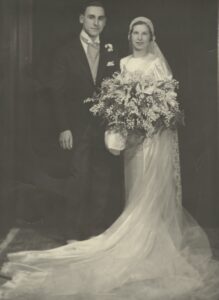
Wedding of Sylvia Lillian Cohen (daughter of Lyon Cohen) and Sydney J. Cohen of England, October 17, 1933. The ceremony took place at the Shaar at 3:00 pm and was officiated by Rabbi Herman Abramowitz. According to news reports, “a profusion of yellow and bronze chrysanthemums and autumn leaves” were used as decorations throughout the synagogue, and the bride’s veil was a family heirloom.
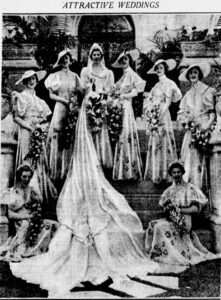
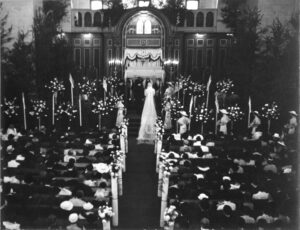
The wedding of Milly (née Bronfman) and Bernard Lande on June 14, 1936. The first picture was published as part of the wedding announcement in the Montreal Star. The second picture is of the ceremony which took place at the Shaar and was officiated by Rabbi Herman Abramowitz.
The Montreal Star reported “effective decorations were carried out in the synagogue with spruce trees as a background and peonies, yellow roses, mauve larkspur and blue delphinium used in abundance, the floral entwined pillars marking the guest pews. Pure white tapers lit the altar amidst the exotic color scheme.”
Further Shaar Weddings in the Newspaper (1930s)
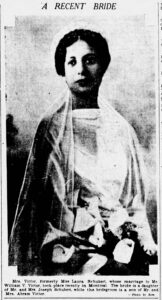
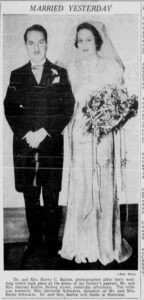
(From left to right)
1. Wedding announcement of Laura (née Schubert) and William V. Victor, January 30, 1935 (Montreal Star).
2. Wedding announcement of Gertrude (née Schwartz) and Dr. Harry C. Ballon, September 14, 1938 (Montreal Star).
Weddings during World War II
In spite of the war, many weddings still carried on the Shaar, many of which were weddings of men in active service, or recent veterans.
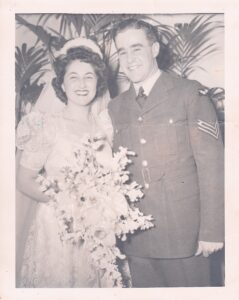
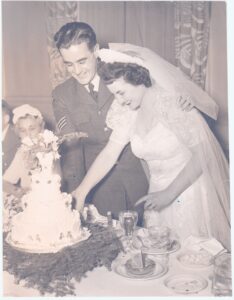
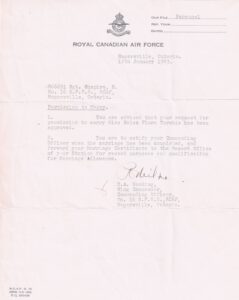
(Courtesy of David Searle)
The wedding of Helen Flora (nee Tarshis) and Sergeant Herbert Shapiro took place at the Windsor Hotel on February 14, 1934, and was officiated by Rabbi Herman Abramowitz, assisted by Cantor Nathan Mendelson. As Shapiro was still in active service, he required permission for leave from the Royal Canadian Air Force (R.C.A.F.).
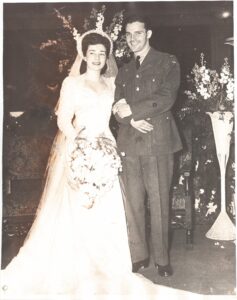
(Courtesy of Anne Kugler)
Wedding of Meta (née Surchin) and Dr. Hyman Surchin, Royal Canadian Army Medical Corps (R.C.A.M.C) on April 12, 1945 at the Shaar, officiated by Rabbi Herman Abramowitz, assisted by Cantor Nathan Mendelson.
Further Weddings of the 1940s
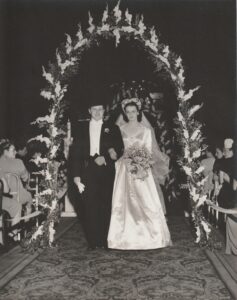
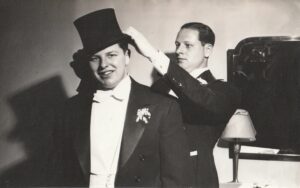
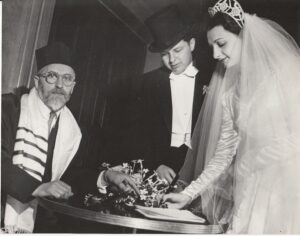
(Courtesy of Marlene Brownstein)
The wedding of Natalie (née Lupovich) and Harold Brownstein took place at the Shaar on June 6, 1946 at the Mount Royal Hotel, and was officiated by Rabbi S. Herschorn.
Shaar Weddings in the Newspaper (1940s)
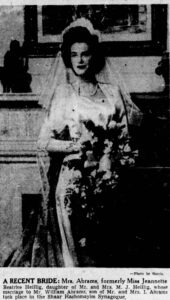
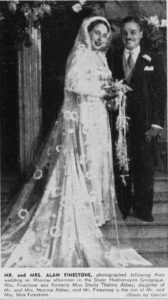
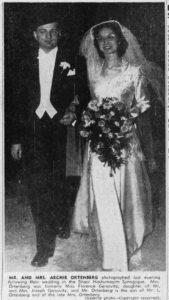
(From left and right)
1. Wedding announcement of Jeannette (née Heillig) and William Abrams, March 1, 1944 (Montreal Star).
2. Wedding announcement of the Honourable Sheila (née Abbey) and Alan Finestone, June 11, 1947 (Montreal Star).
3. Wedding announcement of Florence (née Gersovitz) and Archie Ortenberg, January 21, 1949 (Montreal Star).
Since beginning work on the Shaar’s archives five years ago, we have made some fascinating discoveries. But as we came to know the contents of our rich archival materials, we also noticed what was absent. In archival language these are known as ‘collection gaps’ — important parts of our history, community, and heritage which are lacking in documentation. One of these gaps was material related to weddings. And so, over the course of this summer, the Shaar Archives has embarked on one of our most ambitious collecting projects to date: documenting the long history of Shaar Hashomayim weddings.
The response from the Shaar community has been tremendous. Throughout the summer we have received hundreds of your photographs and heard many of your stories. This has been a true collaboration between the the Shaar family and the Archives, and has significantly enriched our collections. In this article, we highlight some of the earliest wedding-related archives in our collections, from the 1910s to the 1920s. This article is the first in a series in which we will be showcasing Shaar weddings through the years.
A Shaar Bride
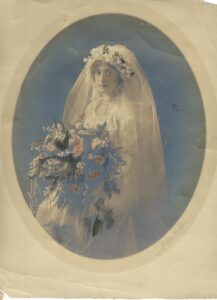
This photograph of a Shaar bride was taken in the 1910s. The picture was originally taken in black and white, with colour added at a later date (as can be seen on the bride’s cheeks and flowers). The bride in this picture is not identified.
The Engagement of Rabbi Herman Abramowitz
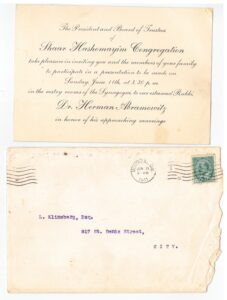
When Rabbi Herman Abramowitz was hired by the Shaar in 1902, he came to the synagogue as a bachelor. Some years later, in 1911, after officiating at numerous weddings, it was finally his turn. Rabbi Abramowitz became engaged to Theresa Bockar of New York. In honour of his upcoming marriage (which took place on June 22, 1911), on June 11 the Shaar the held special ‘presentation’ (an engagement party) for Rabbi Abramowitz in the McGill College Synagogue (invitation below).
A Double Wedding
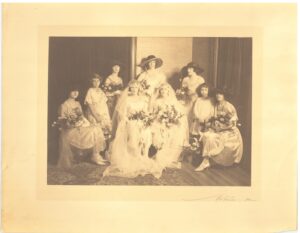
The two brides Sadie Brown and Celia Levin photographed for their weddings on December 7, 1921. Photo courtesy of Anne Kugler (granddaughter of Celia Levin).
On December 7th, 1921, a wedding of particular note took place at the Shaar (in the previous building on McGill College): the double wedding of sisters Celia and Sadie Freedman, who married Leon Levin and Moses A. Brown respectively in ceremonies which took place within one hour of each other. The weddings were co-officiated by Rabbi Dr. Herman Abramowitz and by Montreal’s Chief Rabbi, Hirsch Cohen. A reception was afterwards held at the Ritz Carleton to which more than 600 people were invited (see side panel for the newspaper clipping from The Montreal Star.
A Wedding for Doda Leba
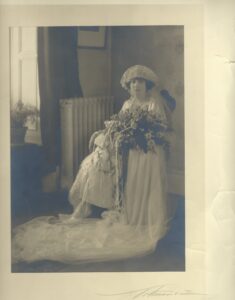
Known to generations at the Shaar as ‘Doda Leba’ who served as organist and accompanist for a half century at the Shaar, playing at many Shaar weddings, Leba Fineberg (née Livingstone) herself had her own Shaar wedding. On May 16, 1922, at a ceremony officiated by Rabbi Herman Abramowitz, she married Dr. Moe N. Fineberg.
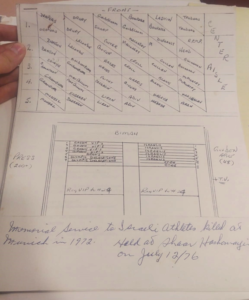
This year marks 50 years since Montreal hosted the 1976 Olympics. Given that these Olympics were the first Summer Olympics after the massacre of 11 Israeli athletes at the 1972 Munich Olympics, the Jewish community felt it important to hold a memorial service. At 7:00 PM on July 12, 1976, less than a week before the Summer Olympics in Montreal, a memorial organized by the Jewish Community of Canada (chaired by Allan Bronfman) was held at the Shaar.
The memorial was open to the public, and notices were published in both French and English newspapers.
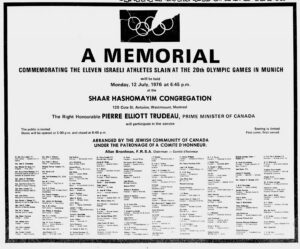
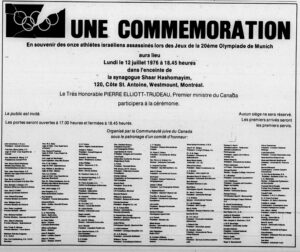
The Shaar’s Archives has a copy of the service programme. The service was officiated by Rabbi Gunther Plaut, Rabbi of Toronto’s Holy Blossom Temple. Other participants included the Shaar’s Rabbi Shuchat, Israeli Ambassador Mordecai Shalev, and the Shaar’s Cantor Joseph Gross.
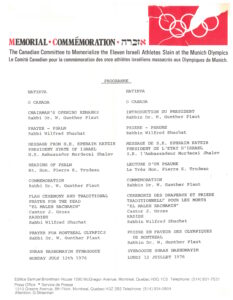
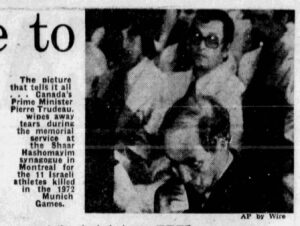
Perhaps most notably, the Right Honourable Pierre E. Trudeau, then Prime Minister of Canada, took part in the ceremony, reading out an excerpt from Psalms. Trudeau was moved by the ceremony, and many reports noted that he openly wept during the memorial service.
The Shaar’s Archives also has the seating plan for the evening, which notes many other notable people in attendance including Quebec Premier Robert Bourrassa, Montreal mayor Jean Drapeau, and International Olympic Committee chair Lord Killanin, among many others.
The Montreal Gazette initially reported over 1,800 people in attendance. Later reports suggested as many as 5,000 people attended, with overflow rooms set up in the Shaar’s other halls, where video reception was set-up. Honoured attendees included massacre survivor Esther Roth, the widows and relatives of three of the murdered athletes, as well as 60 members of the 1976 Israeli Olympic team.
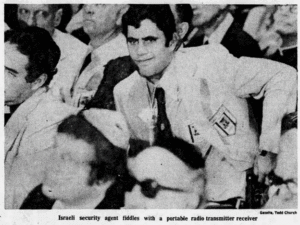
Security for the memorial service was heavy. The building was sniffed by three RCMP dogs for explosives before the Israeli athletes arrived. Moreover “a Canadian Armed Forces helicopter hovered overhead and combat-ready stood guard around the synagogue” and plainclothes policemen where stationed throughout the building.
The Shaar’s September 1976 bulletin notes that the memorial took place following “the refusal of the Olympics authority to include a two minute ‘silence of memorial’ at the opening ceremonies of the Montreal Olympics.” As we now know, it would be many, many decades until the International Olympic Committee would memorialize the massacre during active Olympic events.

From June 21 to 25, Shaar Archivist Hannah Srour-Zackon was in Evanston, Illinois, at the annual Association of Jewish Libraries (AJL) conference, which brings together professionals working with Jewish collections in libraries and archives around the world.
Hannah gave a presentation about the Shaar’s archives, in particular about the papers of Cantor Nathan Mendelson z”l (“The Hazzan in the Archive: Processing the Papers of Cantor Nanthan Mendelson”), which were donated to our archives last year. The presentation was received with great interest and sparked conversations about how the papers of other cantors as well as hazzanut-related collections are being preserved and used around the world. During the conference Hannah was also re-elected for a second term on AJL’s board as Vice-President for Development
Nathan Mendelson was the Shaar’s longest serving hazzan, hired in 1938 and retired after 35 years in 1973. He remained emeritus until his sudden passing on Rosh Hashanah in 1977. In addition to playing a fundamental role in shaping the synagogue’s music for a quarter century, he was very active in hazzanut circles both locally in Montreal and internationally. He served as President of the Montreal Jewish Music forum and Montreal Jewish Music council, Vice-President of the Montreal Cantors Council, and, most notably, President of the Cantors Assembly of America. He composed many original pieces, some of which he wrote with his wife Mae Chazin Mendelson (herself from a cantorial family), a graduate of Julliard’s School of Music. Cantor Mendelson also taught adult education classes throughout the Montreal Jewish community and served as the official mohel of the Shaar. After his death, his family established the Hazzan Nathan Mendelson Music Foundation in his memory for the synagogue to fund Jewish music and cantorial initiatives, recordings, and events.
We are very excited to announce a new partnership with the Association of Jewish Libraries (AJL) —the leading authority on Judaic Librarianship—with a newly launched page on the Shaar’s Archives featured on AJL’s ‘Donna and Richard Harris Jewish Libraries, Archives, and Collections Around the World’ site.
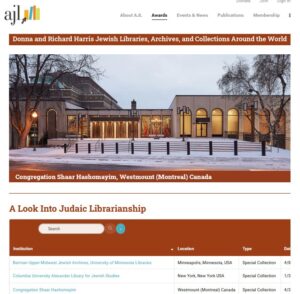
The goal of ‘Jewish Libraries Around the World’ is as follows:
There are hundreds of magnificent Jewish libraries, collections, and archives that can be found in colleges, universities, day schools, community centers, and synagogues. They contain rare books, unique book collections, ephemera, beautiful art, and much more. However, until now there has been no central location where an interested person can learn about the breadth, beauty, and history of these institutions.
With the generous support of the Harris Family Private Foundation, the Association of Jewish Libraries is creating a searchable web portal featuring these treasures. Each participating institution has a page outlining its work, history, and unique collections.
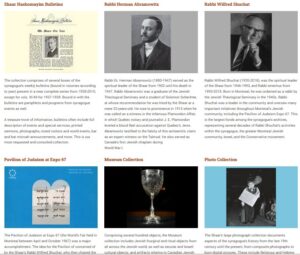
The new ‘Shaar’ page features the history of the synagogue, our archives, highlights from among our collections, programs, and more! It also situates our collections among an international network of important and notable Jewish collections. A big thank you to Jerry Krautman, AJL’s Development Consultant, who helped us design and develop our page.
The Shaar’s archives regularly receives a diverse range of research questions. One of the most frequent subjects we are asked about is Leonard Cohen, whose ties to our congregation run generations deep. Over the past few years, there have been several very interesting projects which draw upon the Shaar Hashomayim’s archives.
In this first edition of a new series called “Ask the Archivist”, with Shaar Archivist Hannah Srour-Zackon, we will be featuring the kinds of questions we receive and how people use our collections. This time we are showcasing:
How are our collections used for Leonard Cohen-related research?
Little People, Big Dreams: Leonard Cohen (2024)


In 2023, I was contacted by Frances Lincoln Children’s Books (an imprint of Quarto Books) to consult on an upcoming book on Leonard Cohen as part of their bestselling Little People, Big Dreams series. They asked many detailed questions about our synagogue and I was impressed by their care to ensure accurate depiction of Leonard Cohen’s childhood and Jewish upbringing within the Shaar. I shared with them archival photographs from our collections for reference as well as historical details.
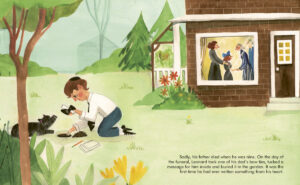
The book, published in 2024 in both English and French, is beautiful. The attention to detail emerges in such things as a young Leonard Cohen’s ripped tie while sitting shiva for his father – a nod to the Jewish custom to wear torn clothing (kriyah) during the period of mourning.
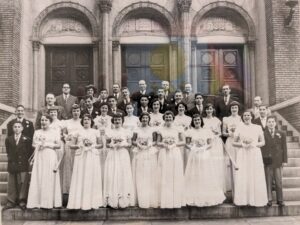
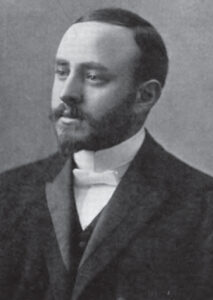
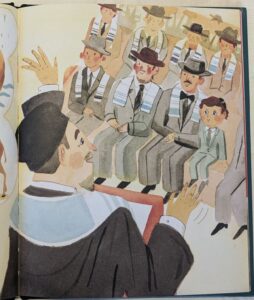
They have also captured the Shaar’s typical dress for a Shabbat service from this era among other things. One detail I especially like is their drawing of a rabbi speaking from the lectern in the sanctuary a as a young Leonard sits during services. The rabbi in question is a rendering of then-Shaar rabbi, Rabbi Dr. Herman Abramowitz (pictured below), illustrated based on the Shaar’s photograph collection.
This was a fascinating project to have been involved with – as an expression of gratitude. The Shaar’s archivist is thanked in the acknowledgments on the copyright page: “Grateful thanks to Hannah Srour-Zackon for her consultation”.
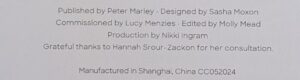
So Long, Marianne (2024)

In the summer of 2023, the limited series So Long, Marianne, about the relationship between Leonard Cohen and Marianne Ihlen, was filming in Montreal, starring Alex Wolff as Leonard Cohen. The production team reached out to us with a unique request: to give a tour of the Shaar to Alex Wolff and show him some Leonard Cohen-related materials in our collections to gain a sense of his childhood in our community. Hannah Srour-Zackon, Claire Berger, and Carole Rocklin provided the tour to Alex Wolff—who came completely in character as Leonard Cohen. We showed him “his” graduation picture, the bulletin from “his” bar mitzvah as well as mentions of “him” in other bulletins, and some of the prayer books belonging to grandfather Lyon Cohen.
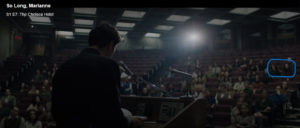
Later, we were invited to the set to watch a scene being filmed on the McGill University campus, and even sat in the audience as extras. So Long, Marianne premiered in 2024 and is available to watch on Crave in Canada.
“A Tale of Two Cohens: Purim in Montreal”
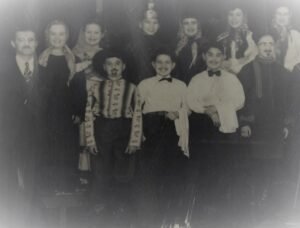
In 2022, after a chance interaction on X (formerly Twitter), Hannah Srour-Zackon was invited to write a Purim-themed article for the Jewish Review of Books using materials in our archives. The final piece was published on the online edition in March and is built around materials in our archives relating to a Purim spiel performance a young Leonard Cohen was a part of in 1947, and an earlier Purim spiel which his grandfather Lyon Cohen wrote and and in which he starred in 1885.
If you are unable to access the article and would still like to read it, please contact Hannah Srour-Zackon.
Do you have your own Leonard Cohen-related research questions? Get in touch with us at hsz@theshaar.org or museum@theshaar.org
In September 2023, prominent Canadian Jewish artist Yehouda Chaki z”l passed away at the age of 84. Among the many wonderful contributions to art in Canada, Chaki, a long-time member of our own Shaar community, was behind the design of the two beautiful tapestries sewn by the Sisterhood, depicting scenes from Bereshit, which hang in our building. This week, as we begin another Torah reading cycle on Simchat Torah, we pay tribute to Yehouda Chaki and the two tapestries.
In The Beginning
The first Chaki-designed tapestry, “In The Beginning”, was unveiled by the Sisterhood in 1982 and took two and a half years to complete. In the fall of that year, at the reception preceding the Slichot services, the Sisterhood sponsored a vernissage of the tapestry as part of the Westmount Arts Festival. This was the first public viewing of the tapestry, and was attended by guests and officials of the City of Westmount, along with Sisterhood members who made squares in the tapestry and Yehouda Chaki himself
Let There Be Light
In 1992, in time for the Congregation’s 145th anniversary, the Sisterhood unveiled its second needlepoint tapestry designed by Yehouda Chaki titled, “Let There Be Light”. This was another great undertaking by members of the Sisterhood who each completed squares of the tapestry. The Committee for this project was chaired by Mildred B. Lande, C.M., and Carol Koffler.
Further reading on Yehouda Chaki
Brownstein: Chaki was one of Canada’s most prominent and prolific artists
Obituary: Yehouda Chaki, 84, expressed both joy and pain in his vibrant paintings
With Remembrance Day around the corner, this week we pay tribute to a member of our community- Rabbi Dr. Samuel Cass z”l (1908-1975)—who served as army chaplain to Canadian Jews in World War II and was for many years the Rabbi of the community hall service at the Shaar.
Born in Toronto, Rabbi Cass gradated from the Jewish Theological Seminary in 1933 after which he served congregations in Vancouver and Seattle before World War II. He would also occasionally substitute for Rabbi Herman Abramowitz at the Shaar during the latter’s summer vacation. His relationship to the Shaar was cemented when he married Annabel Goldfine who was also of the synagogue’s community.
In 1942, Rabbi Cass along with Rabbi Gershon Levi (a past educational director of the Shaar) were named as the two full-time Senior Jewish Chaplain to the Canadian Armed Forces, with Rabbi Cass stationed at home. Later, in 1944, Rabbis Cass and Levi swapped positions, and Rabbi Cass was sent overseas. Among his many services to Jewish soldiers, he oversaw religious services and holiday celebrations. In 1944, he organized a Chanukah party in Antwerp for soldiers as well as for 250 local children.
In March of 1945, he held a service in Kleve, Germany outside the Reichswald Forest – which in February of that year had been the site of the Battle of the Reichswald fought by Canadian and British forces (allied victory). Following this Battle, it became the site of the largest Commonwealth cemetery in Germany.
Rabbi Cass’ service was to make its mark beyond his chaplaincy services to Canadian soldiers – in that same year, he was the first Jewish chaplain to enter concentrations camps which were liberated by the Canadian Army and played an instrumental role in rehabilitating the survivors, and in helping Belgium and Dutch Jewry.
After the War, he was honourably discharged with the rank of Major and would then go on to work for many years as the Director of Hillel before his tragic death in 1975.
Further Reading: Rabbi Herman Abramowitz and Jewish Chaplaincy Services During World War II; Rabbi Dr. Samuel Cass, Shaar Hashomayim Cemetery
“Yom Kippur will never be the same again,” begins a message written by Rabbi Wilfred Shuchat in 1973. This year we mark the 50th anniversary of the outbreak of the Yom Kippur War, one of the greatest threats to the State of Israel since its independence in 1948. There to bear witness to the conflict was none other than Rabbi Shuchat, who wrote back messages to the Congregation as it unfolded (full letters at the end).
Rabbi Shuchat was honoured with a sabbatical soon after celebrating 25 years with Shaar Hashomayim and went with his family to spend the year (from July 1973 through the summer of 1974) in Jerusalem. Though Rabbi Shuchat returned to Montreal for Rosh Hashanah and Yom Kippur, he went back to an Israel embroiled in war.
The words Rabbi Shuchat wrote in his messages to the Congregation as the Yom Kippur War progressed deeply reflect the severity of the situation, while also foreseeing its lasting impact and significance. “For the past two weeks I have been living in the very center of those dramatic events that will determine Jewish history for the future and will certainly have a momentous effect upon the course of the world.”
Writing on October 23rd, 1973, just two days before it officially came to an end, Rabbi Shuchat offered three conclusions to be drawn from the War as Israel, the Jewish Diaspora, and the world moves forward, the third of which is a resounding and heartfelt declaration of the bond between Israel and the Diaspora as one Jewish people.
READ: A message from Rabbi Shuchat, War Letter from Israel
This Fall will mark 75 years since the Rabbi Herman Abramowitz Building (Educational Annex) was formally dedicated. As we gear up for back-to-school we’re looking back on the day the school building was officially opened.
The educational centre was a longtime the goal of Rabbi Herman Abramowitz, who was a strong advocate for Jewish education. In the years leading up to it’s opening, the Shaar’s Westmount building (which had been built just 26 years prior) was already bursting at the seams and the need for additional space for the synagogue’s educational activities was abundantly clear. While World War II did delay progress, by the time the Shaar’s centennial year in 1946-7 the necessary funds were secured.
On October 31, 1948, the building officially opened following a beautiful dedication ceremony during which then Shaar President Moses J. Heillig was presented with a commemorative silver trowel.
Unfortunately, Rabbi Abramowitz would not live see the building’s completion as he passed away after a long illness in October 1947. However, his legacy of dedication to Jewish education as the building was dedicated in his name.
Read the programme from the dedication service